


Winds of change: Centro para Mudanças Exponenciais (CMe)
It goes without saying that access to information is essential for citizens to secure their rights – a fundamental aspect of a democracy. After all, this is the only way they can learn about existing public policies, the services available to them in their surroundings, and actively participate in and occupy educational, healthcare, leisure spaces, and more.
How to ensure access to information in a context where 47 percent of the Brazilian population avoids the news*? And where more than half of Brazilians consume news content only through social media, but millions of people run out of mobile data before the end of each month? Not to mention that more than half of Brazil’s municipalities are news deserts – meaning they do not have local media outlets, a scenario that impacts more than 30 million Brazilians**.

Learn more:
- *Digital News Report, by the Reuters Institute (2024)
- **PROJOR’s News Atlas, by PROJOR (2018)

Desenrola e Não Me Enrola is an organization for Solutions Journalism and Anti-Racist Media Literacy established in 2013. It works to develop, implement, and scale information and educational technologies focused on preventing and fighting information inequalities, including disinformation, news deserts, media illiteracy, and digital segregation, in urban peripheries, favelas (slums), quilombos (maroon communities), and Indigenous lands across Brazil, to promote systemic change in the brazilian landscape of the right to information and communication, inspiring and co-creating policy innovation to bring these populations closer to social rights, social participation, journalism, and democracy.
How is it possible, then, to address this increasingly complexchallenge, and what new approaches would be necessary tosolve problems as they arise?
Desenrola e Não Me Enrola, a journalism initiative working with the pillars of Training and Content and focusing on thecultural identity of the peripheries of Brazil, has been askingquestions like these for over 13 years. They have alreadystarted to answer some of them and, more than that, designconcrete pathways to solutions, drawing from the experiencethey have had since being nominated by Instituto Beja in 2025– after receiving institutional support in 2024 – to be part ofthe exponential change journey of the Centro para Mudanças Exponenciais (CMe).

“Instituto Beja has the ability to see Desenrola e Não Me Enrola as an organization that produces futures, knowledge, and practical actions that can inspire, both collectively and systemically, new paradigms and pathways for policy making adapted to different social, cultural, political, economic, and technological contexts in Brazil’s urban peripheries, favelas, quilombos, and Indigenous lands. In other words, by recognising not only our projects, but also the different dimensions of our work, Beja is promoting a revolution in the field of philanthropy. This is why we consider this partnership with Instituto Beja one of the most innovative and promising partnerships we have ever had.”
Ronaldo Matos
Executive Director and co-founder of
Desenrola e Não Me Enrola
CMe is the Brazilian hub of the Centre for Exponential Change (C4EC), a global network supporting System Orchestrators* co-founded by Instituto Beja and five other philanthropic organizations from different continents – Nilekani Philanthropies (India), New Profit (USA), Skoll Foundation (USA, with international operations), Waverley Street Foundation (USA, with international operations), and Yellowwoods Foundation (South Africa).In Brazil, CMe is incubated by Instituto Beja, which will invest US$10 million by 2029 to support at least 20 organizations on their journey towards exponential change in Brazil. It will also fund part of the costs of the Brazilian hub.
Centro para Mudanças Exponenciais (CMe) was born with the mission to enable social change emerging from brazilian society at scale, with speed, and sustainably.
“At CMe, our mission is to put into practice the kind of philanthropy that Instituto Beja believes in: collaborative, innovative, bold. Collaborative because we understand that philanthropic capital will always be smaller than the scale of the problems it aims to solve. And one of the ways to address this is precisely to understand that one foundation will not have all the necessary resources to meet the challenge. But in collaboration with civil society, the private sector, and governments, it is possible. When we talk about innovation, the question is: ‘Who is innovating?’ What is the point of reference and context? At CMe, this is about how to make a scalable, faster, sustainable impact, drawing from a Global South reference. That is innovation. And it is bold because it invests in a proposal that takes risks, incubating the Brazilian hub of the network, where we have the possibility of testing, making mistakes, and getting it right, making a long-term commitment to bring this approach to the country.”
Fabio Tran
Director of CMe and Member of the Executive Committee of Instituto Beja
CMe proposes a change of mindset, a new way of thinking about scale. The current prevalent logic among most foundations and philanthropies is to scale up – i.e., to increase the reach and replicate – of what already works, which in many cases is a pilot programme that has achieved good results in a specific context. But replicating that in different scenarios would not account for the diversity of a country as large as Brazil.
As a result of that prevalent logic, scale is ultimately imposed from the top down. No incentives are given to the distribution of agency – that is, when individuals have the freedom and power to make decisions for their lives – among the different actors involved, nor is there a strong focus on access or on building open and shared infrastructure or spaces for collaboration and networking. Diversity then often becomes an operational challenge.
What CMe is effectively doing is creating the conditions in which change is no longer incremental but becomes exponential: more connected actors, more value per interaction, more impact at a lower cost.
Work fronts
CMe understands that exponential change happens when entire systems begin to operate in an inclusive, innovative, and structuring manner. Aiming to solve social challenges at scale, with speed, and sustainably, CMe works on two fronts:
- Support System Orchestrators: change leaders who shape different paradigms, typically working in impactful organizations with a high potential for ideation and execution that can generate positive social change, bringing together different actors around a relevant cause;
- Bringing together leading intellectual references and local voices addressing topics including climate, education, health, livelihoods, and equity to co-build system-wide Strategic Blueprints, i.e., action plans that combine and align strategies and forces from the public and private sectors, academia, and civil society.
“At CMe, we encourage supported organizations to invite others to collaborate and design together, from the outset, what will work at scale, restoring the agency of all actors and sectors involved, each in their own context. We support the development of spaces for co-creation as a network, sharing existing knowledge, encouraging collaboration, and distributing the ability to solve throughout the ecosystem. Finally, we foster the construction of infrastructure to sustain this collaboration at scale and at low cost, which usually leads to the construction of open and interoperable digital infrastructure – i.e., allowing systems to smoothly communicate and work together, advancing more quickly and sustainably. This way, scale emerges in an organic and coordinated manner. And diversity becomes our main asset.”
Fabio Tran
Director of CMe and Member of the Executive Committee of Instituto Beja
The Journey to Exponential Change
The journey – designed by C4EC – supports social leaders in using “Societal Thinking”* to increase the scale, speed, and sustainability of the change promoted by their organizations. It was built to help them overcome seven “chasms/ barriers” that they need to cross as transformative leaders: knowledge, reimagination, conviction, design-action, coordination, mobilisation, and self-efficacy.
To help them overcome these barriers, the journey is divided into three phases:
Phase A: Strategic Design (3 - 6 months)

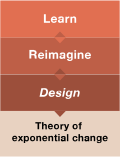
Dive into the challenge to identify:
What can help scale up, speed up, and sustain the change?
Phase B: Prototyping (6 - 9 months)

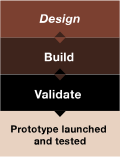
Build prototypes using open digital resources knowledge, processes, technologies, connections, data) and expertise from the C4EC network.
Phase C: (2th years onwards)

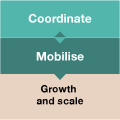
The C4EC network can help:
• Coordinate different actors (Governments, Civil Society, Markets, Communities)
• Mobilise different resources (funding, expertise, partnerships, access to communities)
On the journey, leaders have access to:
- Open practical knowledge – why, what, and how to pursue exponential change;
- Deep design and prototyping support – support from the local design team and partners to apply the approach in the context of the organization;
- Financial support;
- Hands-on mentors; and
- Support for the development of their own self-efficacy.
This gives organizations the autonomy to orchestrate systems grounded in scale, speed, and sustainability.
Phase A: Strategic Design (3 - 6 months)
Dive into the challenge to identify:
What can help scale up, speed up, and sustain the change?
Phase B: Prototyping (6 - 9 months)
Build prototypes using open digital resources knowledge, processes, technologies, connections, data) and expertise from the C4EC network.
Phase C: (2th years onwards)
The C4EC network can help:
• Coordinate different actors (Governments, Civil Society, Markets, Communities)
• Mobilise different resources (funding, expertise, partnerships, access to communities)
On the journey, leaders have access to:
- Open practical knowledge – why, what, and how to pursue exponential change;
- Deep design and prototyping support – support from the local design team and partners to apply the approach in the context of the organization;
- Financial support;
- Hands-on mentors; and
- Support for the development of their own self-efficacy.
This gives organizations the autonomy to orchestrate systems grounded in scale, speed, and sustainability.
In real life: the Journey of Desenrola e Não Me Enrola
Ronaldo Matos, Executive Director of Desenrola e Não Me Enrola, shares how he has experienced this journey in real life. He says the journey at CMe has allowed desenrola to organise their activities and assess the way they build networks and coalitions.
“A key point that CMe brought to our attention was the importance of restoring people’s agency, which was something we already did, but we could not fathom how to do it at scale. And CMe showed that it is possible to do it in a more organised and systemic way. It also pointed out that we need to learn to orchestrate other actors who can support the public debate and join forces in our journey. It is a revolutionary process”, he argues.
They started their journey effectively mapping out what was common to all institutions that work like Desenrola in fighting disinformation in the country and carrying out initiatives that expand people’s access to quality information, in order to think about how to chart a path for exponential change in this field.
“We identified all the lessons we had learned, the mistakes we had made, and the things we had done right with our experience building digital infrastructure for journalism, which is Território da Notícia* . We saw that this is the way forward. From there, we began to develop the actions that could be taken within the cycles of the CMe journey”, Ronaldo explains.
Desenrola will now focus on starting to co-create and co-build the first digital public infrastructure for a journalism and media education ecosystem in Brazil, introducing their proposal to sectoral entities, federal government leaders, philanthropic organizations, academic centres, and state journalism networks in Brazil.
To put this initiative into practice, Desenrola is developing a prototype to test how to distribute, in this interconnected community, the capacity to prevent disinformation across urban peripheries, favelas, quilombos [maroon communities], and Indigenous lands. The proposal is being developed in partnership with the Brazilian National Council of Extractive Populations (CNS), a social movement active in Brazil’s Legal Amazon, to operate in more than 20 municipalities in the state of Pará over the next three years.
Their goal is to implement the methodology of capacity distribution to a larger group of journalism and media education organisations so that they can use this digital infrastructure in their territories and distribute this capacity to other people – that is, a large network will access another until it reaches an expanding territory.
Moreover, the expectation is that the CNS will implement a programme to combat disinformation in extractive territories, mainly impacting young people and women in these areas, so that they have the capacity to prevent other residents from spreading disinformation and start consuming quality news content. Also, with this partnership, the CNS is expected to coordinate and advocate to turn this initiative into public policy.
“When residents connect the news and their own interests to make informed decisions, they begin to demand their rights and also access simple public policies offered where they live that they did not know existed or were not within their reach. This will allow us to restore these people’s agency [when individuals have the freedom and power to make decisions for their lives] and, by applying this strategy at scale, we will achieve exponential change”, the director of Desenrola e Não Me Enrola says.
Lessons Desenrola learned on the journey
- Ensure time and space to discuss, experiment, and apply a new mental model with the organization’s leaders, who, over time, begin to change the institutional culture of their organizations in favour of implementing more systemic projects;
- Support the building and strengthening of partner networks, expanding the number and impact of exchanges between different types of actors;
- Expand the possibilities and mechanisms for building partnerships with public authorities, with a long-term vision, which allows the organization to implement actions based on quality rather than quantity.
Organizations on the journey
2024 cohort

Read more
About the organization
Based on open and collaborative science, the network feeds a platform that integrates satellite imagery, machine learning, and cloud computing. All data, maps, methods, and codes are publicly available free of charge.

Read more
About the organization
Established in 2021 by Amanda Sadalla (holder of a master’s degree in public policy from the University of Oxford) and Stefania Molina (holder of a PhD from the Hertie School), Serenas is a non-partisan, non-profit organization that works to prevent gender-based violence in Brazil. It establishes partnerships with governments (at the municipal, state, and federal level), international organizations, and civil society organizations and it works based on three pillars: education for violence prevention, training for public officials to provide humane care for survivors of sexual and domestic violence, and the production of knowledge that broadens and qualifies the public debate on the issue.
2025 cohort

Read more
About the organization
Conexsus – Instituto Conexões Sustentáveis – is a civil society organization of public interest (OSCIP in the Portuguese acronym) established in 2018. Its work is guided by a vision of impact, in which the socio bioeconomy contributes to the conservation and regeneration of biomes and to climate change mitigation and adaptation, directly impacting the well-being of Indigenous peoples, local communities, and family farmers. To this end, its results- oriented activities and commitments focus on activating the community business ecosystem, expanding the range of solutions and partnerships aimed at strengthening these enterprises and adapted to their organizational needs, consolidating their contribution to income generation in rural areas and to the conservation of forests and biomes including the Amazon, Cerrado, and Caatinga. It has recently expanded its work to the Pan-Amazonian scale, establishing partnerships with organizations in Colombia, Ecuador, Guyana, Peru and Suriname.
Importance of the partnership with CMe
“It is a strategic partnership because it comes at a time of institutional consolidation for Conexsus and represents a fundamental step towards expanding the scale and impact of tried-and-tested solutions, combining technical assistance, access to credit for businesses and families, support for market access, and empowered monitoring and knowledge production. CMe contributes with an exponential perspective on impact, efficiency, and scalability, enabling the expansion of results in a structured manner. This approach is directly connected to the role Conexsus plays in the ecosystem and enhances its ability to generate socio-environmental impact on a larger scale.”
Expectations for the journey towards
the organization’s development
“The partnership with CMe is expected to support the scaling of our financial products, expanding access to capital for the socio-bioeconomy and empowering the preparation of businesses to access these resources. The exponential growth approach presented by CMe is fundamental to this journey, as it contributes to increasing the capillarity and impact of operations, without requiring a proportional expansion of the institutional structure.”

Fabíola Zerbini
Executive Director of Conexsus

Read more
About the organization
SAS Brasil has been working for 12 years to transform the access to specialised healthcare in the country. The organization combines technology, innovation, and social impact in a model that brings together in person and digital care, tending to those who need it most. It is active in more than 350 cities and has provided more than 500.000 consultations, having already benefited 1.5 million people across all regions of Brazil. Recognised by national and international awards, SAS Brasil continues to expand the reach of healthcare with purpose, equity, and joy.
Importance of the partnership with CMe
“The partnership with Centro para Mudanças Exponenciais is fundamental to accelerating our role as orchestrators of systemic change. We also believe in a perspective of structuring a new model of work that starts from the vision of promoting exponential change to ultimately achieve a solution that has the potential to be greater than the size of the healthcare access problem faced in Brazil and worldwide.”
Expectations for the journey towards the organization’s development
“We hope to come out of this journey with a more mature understanding of how to structure a pathway towards a scalable solution. Not only that, but we can connect with a global network of entrepreneurs and partners we can learn from, exchange experiences with, and seek inspiration from for our new phase.”

Sabine Zink
Co-founder and CEO of SAS Brazil

Read more
About the organization
Visão Coop is an initiative dedicated to tackling the climate crisis by bringing together knowledge, technology, and collective action in South America. It maps and activates technologies aimed at biome regeneration and climate adaptation in ecosystems and urban peripheries, promoting structural, territory-based responses to climate challenges using different tools such as digital platforms, audiovisual media, and article production. It also employs tools and platforms to improve digital public infrastructure (DPI) and build a taxonomy of climate action based on local ecological characteristics, guiding preventive and integrated solutions that can reduce risks like floods at their source.
Importance of the partnership with CMe
“We believe that working with CMe will be a turning point for Visão’s strategy as it will empower our model of work to address complex challenges regarding the scale, speed, and sustainability of climate action. CMe contributes to turning structural frictions – like the conflict between the pressing matter of stopping the ‘end of the world’ and the pressing matter of ‘making ends meet’, disinformation, and low institutional engagement – into paths of innovation, through an exponential mindset applied to mobilisation, narrative, and the building of shared capacities.”

Lennon Medeiros
Executive Director of Visão Coop
Expectations for the journey towards the organization’s development
“We hope that the journey towards our organization’s development will consolidate our ability to turn mobilisation into concrete climate impact, strengthening the resilience of communities and territories on the front lines of the crisis. We aim to bring together ancestral wisdom, science, technology and public policies, combining practical and scalable solutions with an accessible, mobilising, relatable climate narrative.”

Fabrícia Sterce
President of Visão Coop
Held in Brazil for the first time, The exChange Summit brings together 150 participants in Rio de Janeiro.
Photo: Jonatha Bongestab
The exChange Summit takes place in Brazil for the first time

Why do we need exponential change now? How can a support network bring about change? What is our individual and collective role in accelerating these changes? These three questions instigated and drove the main reflections and discussions promoted at the 2nd edition of The exChange Summit. The event was held in June 2025 by Centro para Mudanças Exponenciais (CMe) and the Centre for Exponential Change (C4EC), taking place for the first time in Brazil and bringing together more than 150 participants in the city of Rio de Janeiro (RJ).
The main meeting of the global network brought together System Orchestrators, mentors, funders, and leaders from around the world to share lessons, form meaningful connections, and reimagine paths to exponential change.
Over the course of three days, participants had the opportunity to engage in mediated conversations, panel discussions, collaborative practical activities, and interactive experiences, a methodology that reflects CMe’s own approach.
On the first day of the meeting, the session on values as guidelines for positive exponential change, for example, was one of the most highly rated. “Our perception was that, from that moment on, people really felt that they were part of a community – that is, it was not just an event, but they started to see themselves as members of a network, of a relevant community”, Rob Parkinson, CMe’s PMO (Project Management Office) at Instituto Beja, says.
The importance of strengthening networks was also an aspect highlighted in the speech delivered by André Aranha Corrêa do Lago, designated president of COP 30, who attended the event and shared his vision for the future. According to him, collective efforts can drive transformative changes for a sustainable future, especially in light of the climate crisis the world is experiencing.
Another highlight of The exChange Summit were the activities in which entrepreneurs partnering with CMe in Brazil, as well as from other countries, were able to share their experiences, discussing the challenges they faced and the lessons they have learned along the way.
For CMe, holding the event in the country was a milestone in 2025, considering the structuring of the CMe´s actions in Brazil as the first C4EC hub outside India. “For us, it was essential to present CMe and demonstrate its relevance to Brazil’s leadership role in the Global South, which aims to create a community of actors promoting social impact, with a strong partner such as Instituto Beja”, Rob Parkinson argues.
The last day of the event featured a panel discussion entitled “Voices of Brazil: Promoting Democracy, Justice, and Systemic Change.” Three partners of Instituto Beja – Pacto pela Democracia, Iniciativa PIPA, and Abong – Democracia, Direitos e Bens Comuns – provided an assessment of democracy, racial justice, and the philanthropic ecosystem in the country, sharing strategic approaches on these three fronts and stories that reflect the power of connection, listening and collective action.
Some of the main points addressed by the panellists covered aspects such as the importance of including diverse voices that are deep-rooted in the territories and the issues experienced to effectively do so in the face of urgent needs, adding that amplifying these new voices requires clear goals and indicators. Another point they underscored is the need for philanthropy to think and work from the perspectives of communities. “People on the outskirts do not want to be seen as beneficiaries, but rather as partners in co-creation”, Gelson Henrique, executive director of Iniciativa PIPA, argued.
The session also provided participants in the global network with a deeper understanding of the Brazilian context and the importance of this work, which aims to bring about exponential change in the face of complex local challenges.
“The exChange Summit was one of the most significant meetings I have attended in the socioenvironmental impact ecosystem. I would highlight three striking aspects: a Global South perspective on the international scenario, addressing cases and organizations connected to our challenges; the fostering of collaboration to address structural problems; and the diversity and high level of the audience, bringing together leaders who do incredible work, especially from Africa and India.”
Thiago Rached
CEO and co-founder of Letrus
Main outcomes of the meeting
- It strengthened the concept of exponential change for the brazilian public – including actors from civil society, the public sector, and the press – and made it tangible;
- It positioned CMe as part of a global network of trusted relationships;
- It raised awareness among international participants of relevant elements of the brazilian context.

Activity during The exChange Summit.
Photo: Jonatha Bongestab
The event’s key figures:
from 7 countries
conversations
Cristiane Sultani at The exChange Summit.
Photo: Jonatha Bongestab
“The exChange Summit was one of the most inspiring events I attended in 2025. The opportunity to learn from India’s experience about thinking and designing solutions exponentially challenges us to revisit the role of philanthropy in collaborating with systemic change.”
Carla Duprat
Executive Director of Instituto de Cidadania Empresarial (ICE) and member of the Advisory Board of Instituto Beja


